

As PVC shoe accessories become increasingly common in casual shoes, athletic footwear, children's shoes, and personalized footwear, manufacturers and buyers are placing greater emphasis on product consistency and performance. Beyond visual design, technical specifications provide an important basis for evaluating product quality. Well-defined parameters help manufacturers maintain production consistency while allowing buyers to select accessories that suit specific footwear designs and applications.
Material properties are among the fundamental specifications of PVC shoe accessories. Depending on the intended application, PVC can be formulated to provide different levels of hardness, flexibility, and surface characteristics. Manufacturers need to select appropriate material properties according to the accessory's structure and expected use, ensuring that the finished product maintains its shape while remaining sufficiently stable. For accessories that are frequently used or replaced, durability and long-term appearance should also be taken into consideration.
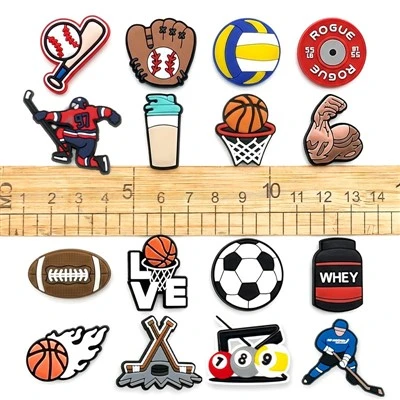
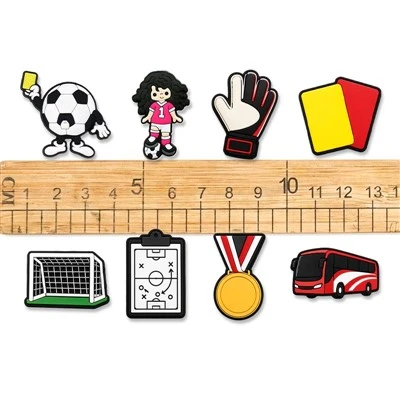
Dimensional specifications determine how well an accessory fits the footwear. Common measurements include length, width, thickness, and overall shape. During production, dimensional tolerances should be controlled according to technical drawings to maintain consistency between batches. For accessories designed to fit specific holes or attachment systems, the dimensions of the connection area are particularly important. Proper dimensional matching helps ensure a secure and reliable fit.
Weight is another relevant specification. Since shoe accessories are generally mounted on the upper, excessive weight may place additional stress on the footwear and affect wearing comfort. For this reason, lightweight construction is an increasingly common design objective, provided that the accessory still achieves the required structural strength and visual effect. The appropriate weight range depends on the accessory's size, construction, and intended use.
Color and appearance should also be managed through clear quality standards. For mass-produced PVC accessories, manufacturers need to monitor color consistency, graphic clarity, surface smoothness, and edge quality. When multiple colors are incorporated into a single design, accurate color positioning and registration are also important to ensure that the finished product matches the original specifications.
Attachment performance is particularly important for functional accessories. Products using snap-fit systems, perforation-based attachments, or other fastening structures should be evaluated for connection stability to reduce the possibility of loosening during normal movement. Where necessary, durability testing can be conducted under conditions that reflect the intended application.
Manufacturers should also establish appropriate inspection standards for appearance, dimensions, and performance based on the specific product. There is no single set of fixed technical values that applies to every PVC shoe accessory. Actual specifications should be determined by the product design, material formulation, manufacturing process, and intended application.
Overall, the technical specifications of PVC shoe accessories cover a range of factors, including material properties, dimensions, weight, color, appearance, and attachment performance. A clear and practical specification system can improve manufacturing control, reduce variation between production batches, and provide more reliable technical support for the large-scale production and customized application of PVC footwear accessories.